


by Sandra Anani
Sandra is the Founder and Director of Sustainability to Action Ltd, a sustainability consultancy based in Abu Dhabi. With more than 25 years' experience, she works with governments, businesses and international organisations to integrate sustainability into strategy, governance and decision-making. Accredited Natural Capital Trainer with Social Value International and has led numerous initiatives on natural, social and human capital, corporate sustainability and responsible business practices.
When I first started working in sustainability more than two decades ago, conversations about the environment were often focused on compliance, emissions and reporting. These areas remain important, but the conversation has evolved significantly. Today, organisations are beginning to ask deeper questions about what truly creates long term value and what enables businesses and societies to thrive.
Increasingly, the answer lies in recognising the relationship between business and nature.
This is the essence of natural capital.
Natural capital refers to the world’s stocks of natural resources, including forests, freshwater, soils, biodiversity and clean air, and the benefits they provide to people and the economy. These benefits support every organisation, whether through the resources they depend on, the services nature provides, or the stability of the systems that enable businesses to operate.
For many years, however, nature was largely invisible in business decision making. It was often viewed as something separate from the economy rather than as a foundation upon which economic activity depends.
That perspective is changing.
Across the world, organisations are recognising that understanding their relationship with nature is becoming increasingly important. Businesses are being encouraged to look beyond their environmental impacts and consider their dependencies on natural systems. Investors, regulators, customers and other stakeholders are seeking greater transparency around nature related risks and opportunities.
This shift represents an exciting opportunity. It allows organisations to make more informed decisions that support resilience, innovation and long term value creation.
What I particularly appreciate about the Capitals Coalition’s approach is that it helps organisations move beyond simply measuring environmental impacts. It provides a practical way of understanding the relationship between business and nature and encourages organisations to consider how different forms of capital contribute to value creation.
The approach helps leaders ask better questions. What resources does our organisation depend on? How do our activities affect the natural world? Where are the risks and opportunities? How can we make decisions that create value while protecting the systems that support us?
Natural capital is not just about environmental management. It is about changing the way we think about value.
Since becoming an Accredited Natural Capital Trainer, I have had the privilege of working with professionals from a wide range of sectors who are exploring how these concepts can support better decision making within their organisations.
One of my favourite moments during training is seeing the conversation change. Many participants initially expect another sustainability course focused on technical concepts and reporting requirements. By the end of the session, they are discussing finance, procurement, operations, risk management, investment decisions and leadership.
They begin to see that nature is not a separate sustainability topic. It is connected to every part of how an organisation creates and protects value.
That shift in perspective is incredibly powerful.
At Sustainability to Action, we believe that building capability is one of the most effective ways to accelerate meaningful change. Frameworks and tools are important, but lasting transformation happens when people have the knowledge, confidence and ability to apply them in practice.
I have learned that organisations rarely struggle because they do not care about sustainability. Often, the challenge is knowing where to start and understanding how these concepts connect to everyday business decisions. Once people recognise the links between nature and business performance, new conversations begin and new opportunities emerge.
This is why training matters.
It creates a shared language across organisations, helping sustainability teams work more effectively with colleagues in finance, procurement, operations and leadership. It enables people to move from awareness to action and from ambition to implementation.
One of the strengths of the Capitals Coalition framework is its flexibility. It provides internationally recognised guidance while allowing organisations across different sectors, regions and stages of maturity to begin their journey in a way that is relevant to them.
Working across the Middle East, I have seen growing interest from both public and private sector organisations in understanding how nature can support economic resilience and sustainable growth. Governments are strengthening their environmental ambitions, businesses are exploring new ways to manage risks and opportunities, and leaders are recognising that protecting natural systems is fundamental to long term prosperity.
Building capability has therefore never been more important.
Developing the skills and confidence of professionals creates impact that extends far beyond a single training programme. It enables organisations to embed better thinking into their strategies, investments and operations. It helps create leaders who understand that sustainability is not only about reducing negative impacts, but also about recognising opportunities to create positive outcomes.
Becoming part of a global network of Accredited Trainers has been a particularly rewarding experience. The train-the-trainer course and accreditation programme, run by Social Value International with the Capitals Coalition, connects professionals around the world who share a common ambition to advance better decision making through the capitals approach. Learning from different sectors, cultures and experiences continues to strengthen the way we deliver this important work.
As interest in nature, biodiversity and integrated decision making continues to grow, there is a growing need for people who can help organisations navigate this transition. Becoming an Accredited Trainer provides an opportunity to deepen your own understanding while contributing to a global movement that is reshaping how organisations think about value.
For those joining one of Social Value International’s upcoming webinars or considering becoming an Accredited Trainer, I encourage you to explore this journey further. Every organisation has a relationship with nature. The opportunity lies in understanding that relationship and using that knowledge to make better decisions.
The future of sustainable business depends on recognising that nature is not separate from our economies or organisations. It is the foundation that supports them. By building the capability to understand and value that connection, we can create businesses that are more resilient, economies that are more sustainable and a future where both people and nature can thrive.
Want to hear more about Natural Capital?
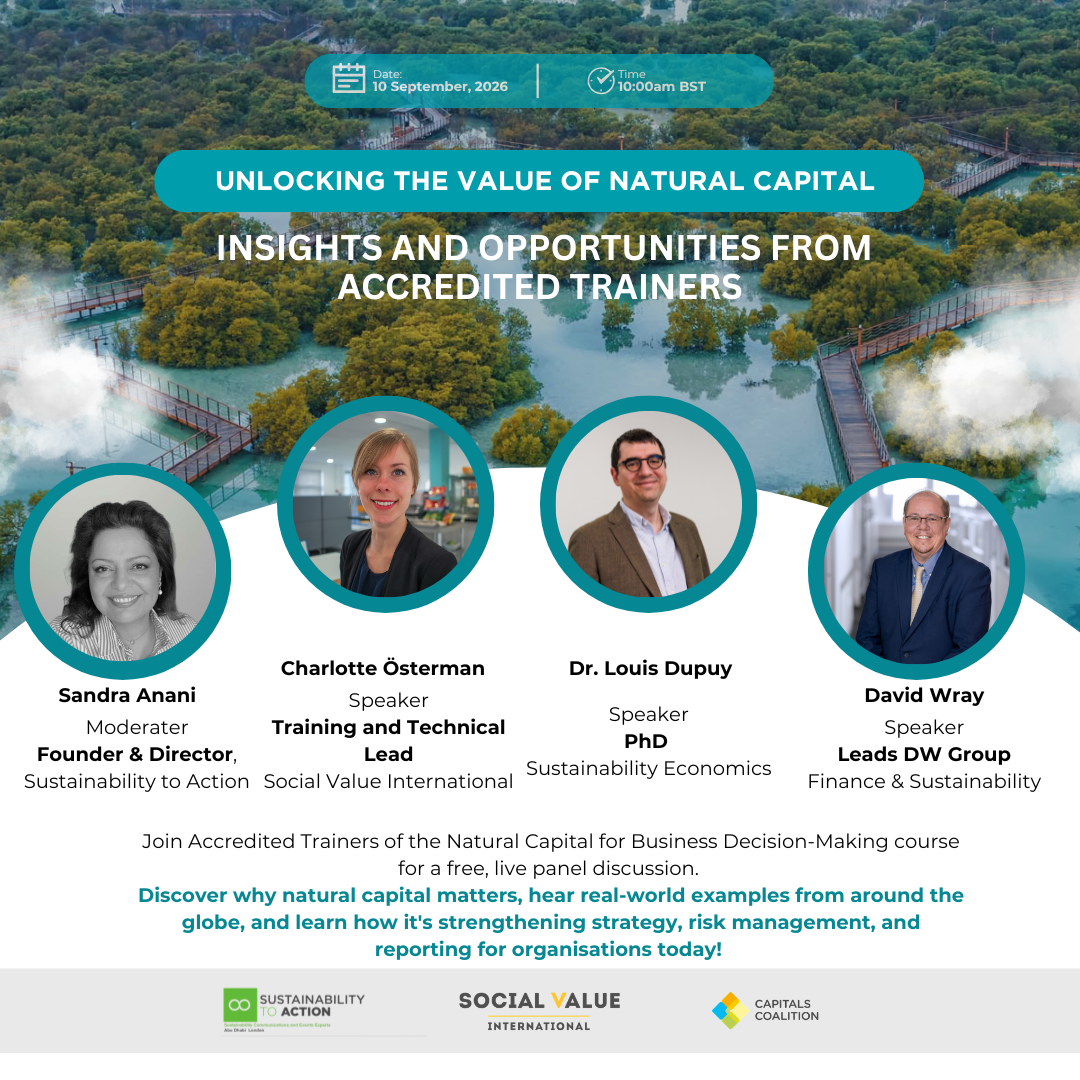
Register for the ‘Unlocking the value of Natural Capital’ webinar
Sandra is hosting a free webinar on 10 September for anyone interested in getting started with Natural Capital. She will be joined by guests including Accredited Trainers of Natural Capital and technical team members from both SVI and Capitals Coalition, providing expert insights, use cases and advice.
Interested in becoming an Accredited Trainer on Natural Capital?
Join our upcoming info session
Join team members from SVI as they guide you through what is required to become an accredited trainer. Learn more about what the course includes, the benefits it offers, and how it is structured. It’s an opportunity to ask questions and hear first hand about how this training has helped others build their skills and grow their careers.