Counting what you do is not the same as proving you made a difference. This piece unpacks the gap between outputs and outcomes - and why closing it is at the heart of credible impact reporting.
By Yulia Romaschenko, Technical Director at Social Value International
You ran a financial literacy course and 200 people showed up. That’s great. So what?
That’s not a cynical question, but the most important one in social value reporting. Because "200 people attended” tells you nothing about whether anyone's financial situation actually improved.
And yet, it can lead to dangerous assumptions. If 200 people attended a training, they must now be more knowledgeable, better at managing money, and less anxious about debt. Some of them may well be. But without asking, you don't know how many, or how much things really changed.
This is one of the most common mistakes organisations make when reporting their impact. They count what they do and present it as evidence of the difference they made. But outcomes aren't for the organisation to define - they belong to the people experiencing them. And you can't know what changed without asking.
Getting this right starts with understanding the difference between two words that get used interchangeably far too often. Outputs and outcomes are not the same thing, and confusing them risks undermining the entire point of measuring impact in the first place.
What are outputs?
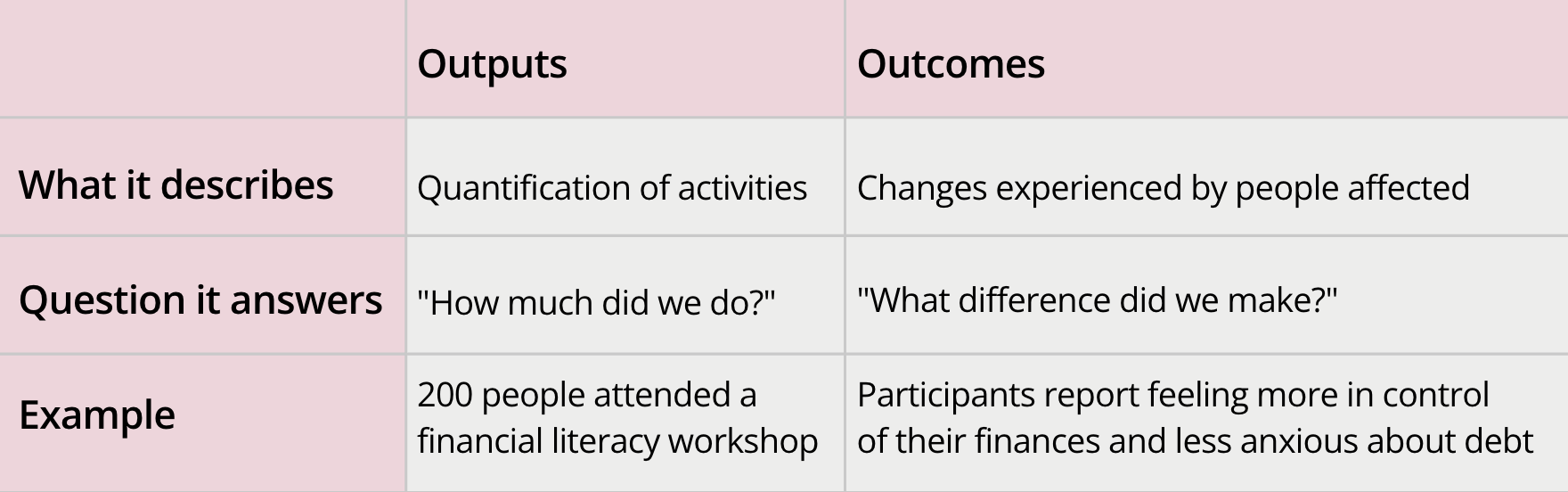
Outputs are what you deliver - the quantification of your organisation’s activities.
Examples include:
Number of training sessions delivered
Number of people who attended a programme
Number of coaching hours provided
Number of jobs created
Number of products or services sold
Outputs are usually tangible and easy to measure, that’s why we are tempted to use them instead of outcomes. However, they don't tell you whether anything changed for the people affected.
What are outcomes?
Outcomes are the changes that result from your activities, as experienced by the people affected. They describe what is different in someone's life, situation, or wellbeing because of what you do.
Examples include:
Increased confidence to manage personal finance among people who completed a financial literacy programme
Employees feeling more supported by their managers following a leadership development initiative
Reduced stress and anxiety related to workload after a company introduces flexible working
Reduced feelings of loneliness among elderly residents supported by a community service
Outcomes can be positive or negative, intended or unintended and even known and unknown when you are affecting somebody indirectly. SVI’s principles, standards and guidance encourages organisations to identify and be honest about all of them.
Summarising the difference
Outputs = what you did. Outcomes = what changed as a result.
Where the Principles of Social Value come in
This distinction sits at the heart of how SVI asks organisations to measure and report. Two of the Principles of Social Value speak directly to the importance of outcomes:
Principle 1: Involve Stakeholders asks organisations to involve the people affected in understanding what changes matter to them. This comes first, because you cannot meaningfully identify outcomes without doing so.
Principle 2: Understand What Changes then asks organisations to understand and evidence changes experienced by those affected. This means identifying outcomes and finding ways to measure them, and not stopping at counting the number of activities delivered.
Principle 5 is also important as it cautions against over-claiming. Presenting outputs as outcomes, or assuming a long chain of positive changes from a single activity without checking, gives an incomplete and potentially misleading picture of your impact.
What this means in practice
Start by asking the people affected what has changed and which changes matter the most. Identify and reach out to those affected indirectly by your activities to ensure you have a complete picture of your impact, including the changes you didn’t plan for and the people you didn’t expect to reach.
Map how your activities lead to the changes experienced by people affected, being realistic about what can and cannot be attributed to your work.
Identify ways to measure those changes – both how many people experience change and how much change happens.
Report honestly on all outcomes, including unintended or negative ones.
Two hundred people attended your financial literacy course. Now go and find out what changed for them. That's not an administrative task - it's the whole point. Outputs tell you what you did. Outcomes tell you whether it mattered.
Latest news